
A Guide to Four Distinct Towns
The aroma hits you before the view does. Warm soil, a faint sweetness carried on the breeze, the dry herbal note of sun-baked hillside. Napa Valley announces itself through the senses before you’ve even found a parking spot, and that first impression sets the tone for everything that follows.
Planning a trip here takes more thought than most people expect. The valley runs roughly 30 miles from south to north, and each town along that corridor has a genuinely different personality. Where you spend your time shapes what kind of day you have. I’ve put together this guide to give you a real picture of each area, including the honest trade-offs, so you can decide what fits your pace, your group, and what you actually want to walk away with.
Let’s start in Downtown Napa and work our way up the valley.
Downtown Napa: The Heart of Accessibility

Here is where I want to spend the most time, because Downtown Napa is where the guide becomes most useful.
The other towns in the valley each have a defining character: Yountville is curated and walkable, St. Helena is historic, and Calistoga is relaxed and outdoorsy. Downtown Napa is all of those things at once, and it adds something none of the others can quite match: density. Tasting rooms sit within a compact, walkable area, which means that on a single afternoon, you can taste different wines and encounter different producers without constantly getting back in the car.
The Downtown Napa tasting rooms range from the spare and serious to the playful and casual, and the variety is genuine rather than manufactured. But rather than trying to fit too many stops into one day, I’d keep it simple.
Azur Wines: A Modern Pause in Downtown Napa
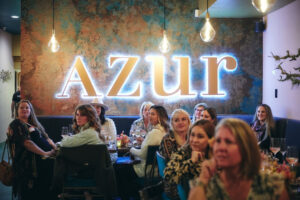 Start at Azur with champagne.
Our Wine Lounge fits into the Downtown Napa landscape in a way that I think reflects what we’ve always tried to do with Azur: create something that feels considered without feeling stiff.
The lounge is an open, modern space with four flight options to choose from: Sip, Sense, Savor, and Champagne. Each one is designed to give you a different entry point into the wines, depending on how much time you have and how deep you want to go. Beyond the flights, we host events throughout the week that include Mahjong, Sip & Paints, ceramics workshops, book clubs, mix-and-mingles, and other fun activities. These aren’t add-ons. They’re part of how we think about what a tasting room should do. Wine is more interesting when it’s part of a conversation, a project, or a shared afternoon.
You can explore our upcoming events and reserve a tasting on Tock before your visit.
Hours are Wednesday through Thursday noon to 7 pm, Friday and Saturday noon to 7:30 pm, and Sunday noon to 7 pm. Monday and Tuesday are available by reservation. I’d suggest a Friday or Saturday visit if you want the full energy of the room, but a quiet Wednesday afternoon has its own particular appeal.
From Azur, head to Vintner’s Collective on Main Street. This one is especially meaningful to us because it’s where we first started selling Azur wines. They highlight hand-picked small producers, many of whom don’t have tasting rooms of their own, which makes it a genuinely interesting place to discover wines you might not otherwise come across.
Then head to Gentleman Farmer Wines. Their small-production wines and welcoming Downtown Napa setting make it an easy next stop as you continue through the neighborhood.
What makes Downtown Napa function as a complete day rather than just a stop is the combination of wine access and cultural activity. You’re not driving from property to property; you’re moving through a city where tasting rooms, restaurants, shops, and community all exist within a few walkable blocks.
Yountville: A Stroll Through Variety
 If you want to understand what makes Yountville work, walk Washington Street on a weekday morning before the crowds arrive. The sidewalks are quiet, and you can see the whole layout at once: a compact, walkable corridor with plenty of tasting rooms within easy reach of one another. That pedestrian-friendly concentration is unusual for Napa Valley, where tasting often means getting back in the car between stops.
That walkability is a major part of the appeal. What makes Yountville worth a full afternoon is the variety. There are many Yountville wine tasting rooms that you can simply pop into, and each offers its own approach to the experience.
Between stops, the Public Art Walk traces a mile-long route through town, and it gives the whole day a different texture. You’re not just moving from room to room; you’re actually moving through a place that has thought about what it wants to be.
St. Helena: A Nod to History

St. Helena earns its reputation for sophistication, but the word that actually fits it better is continuity. This is a town where the past hasn’t been cleared away to make room for the new. It coexists with it, sometimes on the same block.
Beringer Vineyards was founded in 1876 and holds the distinction of being the oldest continuously operating winery in Napa Valley, a California Historical Landmark that still functions as a working producer. Charles Krug Winery, founded in 1861 by Charles Krug himself, is listed on the National Register of Historic Places. Edge Hill Winery, one of the earliest in St. Helena, sits across Sulphur Springs Avenue and predates most of what we think of as the modern Napa wine industry. Walking past these properties, you’re not reading about history on a placard; you’re standing inside it.
Bale Grist Mill State Historic Park, built in 1846, is the longest-operating mill in California and worth the short detour. It’s the kind of place that recalibrates your sense of scale. The wine industry here didn’t appear fully formed. It was built, slowly, by people working with what the land gave them.
St. Helena also holds the former train depot and the Ritchie Block, landmarks that give the main street its particular character. The pace here is unhurried in a way that feels earned rather than performed. I’d give St. Helena a full morning if you’re the kind of traveler who reads the historical markers and means it.
Calistoga: Embracing the Outdoors

Calistoga sits at the northern end of the valley where the hills close in a little and the thermal activity underneath the ground makes itself known. The town has a classic, easygoing, outdoorsy vibe that doesn’t try to compete with the more polished towns to the south. Natural hot springs, outdoor recreation, and a relaxed approach to wine tasting all coexist here without much friction.
Château Montelena at 1429 Tubbs Lane has a well-established name in California wine history and is open to the public. It’s a serious stop for anyone with an interest in how Napa Valley earned its international reputation.
For visitors traveling with children, Calistoga has two experiences that I’d call genuinely worth the trip. Castello di Amorosa is a 14th-century Tuscan castle replica with over 100 rooms, an outdoor area with peacocks, emus, and goats, and grape-juice tastings for kids in the Knights Hall. Sterling Vineyards provides an aerial tram ride up to a hilltop tasting room, with a self-guided tour and terrace tasting, and the gondola back down. Both are among the better family friendly wineries Napa has to offer, and they work precisely because the experience doesn’t ask children to simply wait while adults taste wine. There’s something there for everyone in the group.
The outdoorsy character of Calistoga extends past the wineries. If your trip includes a day that doesn’t revolve around tasting rooms, this is the town where that day fits most naturally.
Planning the Perfect Day
Each town in this valley is worth your time, and none of them is interchangeable. Downtown Napa gives you variety and accessibility in a walkable package. Yountville gives you an easy way to explore a range of tasting experiences. St. Helena gives you depth and historical grounding. Calistoga gives you the most complete outdoor experience and some of the best options if you’re traveling with children.
For a complete day without getting back in the car every hour, Downtown Napa is hard to beat. Come to the Azur Lounge for champagne, then walk to Vintner’s Collective before heading to Gentleman Farmer. Three distinct experiences within a few walkable blocks give you room to enjoy the wines, the neighborhood, and the people rather than spending the afternoon rushing between appointments.
Ready to plan your trip? Explore our upcoming events, join us for Mahjong or a Sip & Paint, or reserve your wine tasting directly through Tock. Explore Events & Reservations.
To building new memories together  ,
,
Elan Fayard